
Energy saving calculators and tools
Charged for Change: Celebrating Women in the EV Movement
The global shift toward electric vehicles (EVs) is more than just a technological revolution—it is a cultural and societal transformation.…
Read More
Energy saving calculators and tools
A Complete Energy Checklist for Your House Move
Moving house is often an exciting milestone—but it can also be stressful and full of details that are easy to…
Read More
Energy saving calculators and tools
From Measurement to Action: A Practical Net Zero Framework for Businesses
As climate change accelerates and regulatory pressure intensifies, businesses across the globe are under increasing pressure to reduce their carbon…
Read More
- All Tools
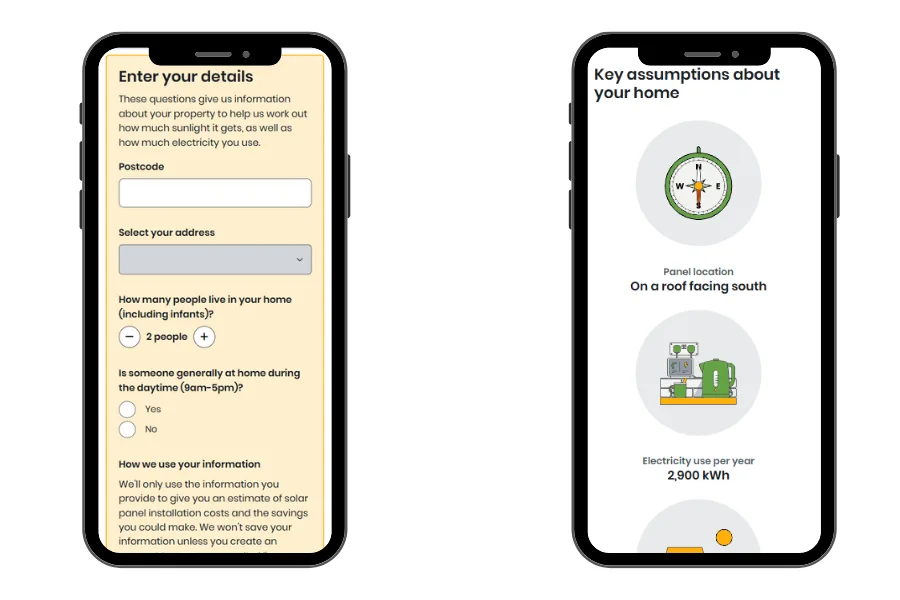
Try our solar panel calculator to estimate the potential savings you could achieve by installing a solar photovoltaic (PV) system in your home.
By simply answering three quick questions, the solar panel calculator can estimate:
- The number of solar panels that would best suit your roof space
- The potential savings on your electricity bills
- The expected installation costs
You can further customize your inputs to get more precise and personalized results.
Once you have your estimates, you can share them with a solar panel installer for expert guidance and a setup tailored to your needs.
For additional details, be sure to check out our solar panel guide.
About the calculator
This solar energy calculator estimates potential payments from a Smart Export Guarantee (SEG). The SEG requires energy suppliers to offer tariffs for the electricity you export to the grid.
Signing up to the SEG isn’t automatic, so you’d need to sign up to the tariff to receive payments.
There are a range of tariffs available for this. Deals may be time limited or have other conditions that you should consider carefully before agreeing to a specific tariff.
Solar Energy UK regularly publishes a league table for the best export tariffs available. We encourage you shop around for the best rate for your circumstances.
Discover the potential savings you could achieve by installing solar panels.
Solar panel calculator FAQs
Why is the tool unable to locate my property?
This tool uses key property information such as:
- The size of your home
- Its insulation levels
- The Energy Performance Certificate (EPC) rating from your property or similar nearby homes
These details help estimate how much electricity your household typically uses and how much you could save with solar panels.
If your home can’t be found in our database, we can still provide estimated savings, but they won’t be tailored specifically to your property.
In some cases, an EPC may not be available—for example, if your home is a new build or has recently been converted.
You can still use the tool to model a non-electrically heated home, or explore general guidance in our solar panel guide. For a more accurate assessment, a solar installer can provide a personalised evaluation.
Is the tool available for use if I live in Northern Ireland?
We don’t currently have EPC data for Northern Ireland in our database, so we’re unable to retrieve details about your property.
However, you can still use the calculator and adjust the results on the personalisation page to better reflect your home.
If your home uses electric heating, you can also refer to our solar panel guide, which includes an example of a Belfast property with solar panels and estimated savings based on typical energy use assumptions.
Homes with electric heating usually see higher potential savings compared to non-electrically heated properties. For a more accurate assessment, a solar installer can provide a tailored evaluation for your situation.
What factors could restrict how much energy my panels are able to export?
In some situations, your Distribution Network Operator (DNO) may place limits on how much electricity you can export to the grid. This is generally done to prevent grid overload in areas with high levels of renewable energy generation.
You can still proceed with installing solar panels even if these restrictions apply, but your installer may need to:
- Install a smaller inverter (which controls how electricity is converted for use and export)
- Add an export limiter device
These measures can reduce the amount of electricity you’re able to export, which may also lower your export payments. Please note that our tool assumes there are no export restrictions, so your actual earnings could vary.
What you should do:
Speak with your installer to find out if any export limits apply to your system and what impact they may have on your returns. They can also check with the DNO on your behalf and guide you through the available options.
What could cause my actual savings to differ from the estimate?
Our estimates are based on typical household electricity usage, covering everyday appliances found in most homes, such as:
- Lighting
- Fridges and freezers
- Cooking appliances like ovens, hobs, and microwaves
- Laundry appliances including washing machines and tumble dryers
- Electronics such as computers and TVs
If your home uses high-demand electrical equipment, your potential savings could be higher than what the tool shows. This is because more of your electricity demand could be met directly by your solar panels instead of the grid.
In general, the more electricity you use during daylight hours, the greater the proportion that can be supplied by your solar system.
Examples of high-consumption appliances include:
- Electric vehicle chargers
- Saunas or hot tubs
- Commercial or workshop equipment used at home
Make sure to inform your installer about any high-energy appliances or special equipment. They can provide a more accurate estimate based on your actual household usage.